Showing posts with label Why We Don't Use FUE. Show all posts

Friday, January 15, 2016

Donor Site Safe Zone


Professor Unger studied 328 men aged 65 years or older and determined the safe donor area (safe zone).
When you are 80 years old, 80% of the chance that  your safe zone at occipital area is only 7 to 8 cm wide, at lateral and posterior area only 5 cm wide.
If grafts harvested are not in the “safe zone” then hair at that area are not permanent hair. When the surrounding hair loss or even get thinner, thousand of scars will appear and extremely difficult to cover up. 


Thursday, January 14, 2016

FUT graft and FUE grafts

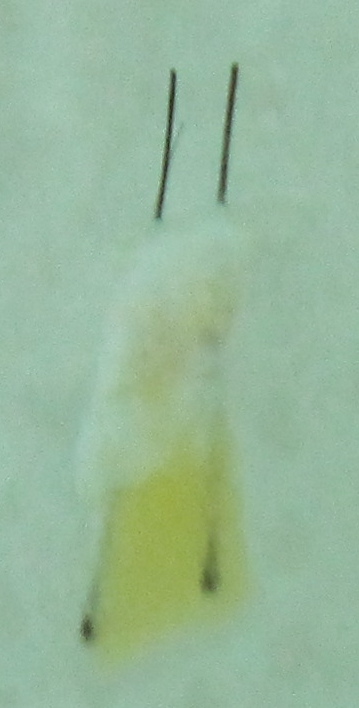
Please see the two photos. The only difference is the FUT grafts have tissue around its follicles and the FUE grafts have no tissue. 

FUE is a blind procedure, the deeper the cutting, the more chance of dissection of the follicles. The standard method is to blindly punch through the skin then use a strong forceps to pull them out. This is the reason why there are no tissues are around the follicle level and the follicle is left exposed with no protection.


FUE Scar with Keloid


A keloid, sometimes referred to as a keloid scar, is a tough heaped-up scar that rises quite abruptly above the rest of the skin. It usually has a smooth top and a pink or purple color. Keloids are irregularly shaped and tend to enlarge progressively. Unlike scars, keloids do not subside over time.

This is a photo of a patient who had keloid and received FUE procedure.


Tuesday, January 12, 2016

Why we don’t offer FUE procedure?

Why we don’t offer FUE procedure?

Because we don’t think it’s your best interest!
Don’t listen to what people tell you! Take sometime, do your study seriously, ask questions, use your own intelligent and make your own decision.
Differences between FUT and FUE:
The only different between FUT and FUE is donor harvesting.
FUT uses blade and FUE uses punch. The recipient site transplant are completely the same.
Different tool used produced different result!


Comparison
FUE
FUT

Is it the latest technique?


Tool
punch
blade

Donor harvesting
blind

Wound treatment

Scar

Scar distribution
(in same length)
5 to 6 times wider
one line only

Total Scar Size


Scar long term effect
permanent
permanent

For keloid patient
easier- only one scar to treat

Quality of graft

Growth rate of transplantation
61.40%
86%
Impact to 2nd surgery
huge-scar tissues change the hair direction
minimum- can use different donor area

Length of hair need to cover up the scar
1 cm
2 cm

Hairstyle options such as marine cut
no

Price
Double


Why most surgeons prefer FUE?


FUE: need only one technician

FUT: need 3-4 technicians
Some surgeons do everything by themselves without hiring any assistance to save on business costs. It is for their own best interest, not yours.

In addition to the overhead expense, the surgery fee is double for the FUE technique. The incentive using FUE for physicians are simply irresistible. Especially for new physician who’s just starting his practice with only 3 to 5 surgeries a month. It’s difficult to start a business when you need to hire 3 to 4 technicians to assist.


ISHRS Warning


Dr. M Beehner’s Study about FUE and FUT


Below is  Dr. M Beehner’s  (3560 hairs/ follicles) study which was presented at the ISHRS annual meeting on Sep 2015.


Please see the two photos. The only difference is the FUT grafts have tissue around its follicles and the FUE grafts have no tissue. 

FUE is a blind procedure, the deeper the cutting, the more chance of dissection of the follicles. The standard method is to blindly punch through the skin then use a strong forcep to pull them out. This is the reason why there are no tissues are around the follicle level and the follicle is left exposed with no protection.

The impact to survival rate is 10-14 months after surgery- 

FUT 86% survival rate (765/890) vs FUE 61.4% survival rate ( 547/890).

The difference is 24.6 %.

We all know donor hair is limited, our worst nightmare is that we might run out of it someday .
Remaining concerns are, what’s the impact to the transplanted hair quality and the life of it? So far no one has done this study.    

FUE Scars


FUE don’t produce linear scar but create thousand of punch scars. To transplant same amount of hair, the scar of FUE will be 10 time more than FUT because FUE wounds are leaved open, so they will keep the same size but FUT wound are closed and almost of the time it will be reduced to 10% or less.  

IMG_8924.JPG


IMG_5257.JPG

More about FUE Scars

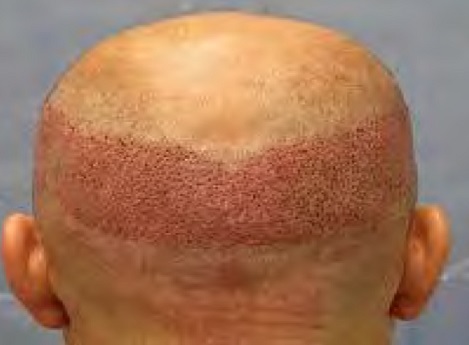
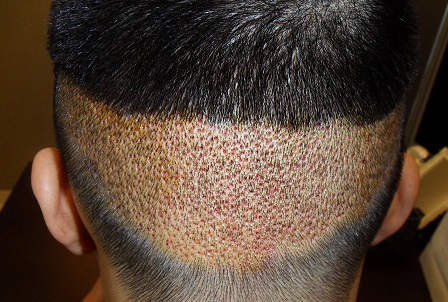
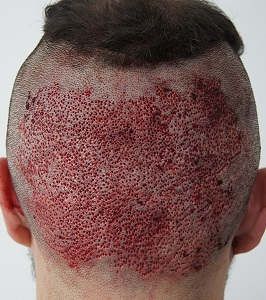
Photos taken immediately after FUE surgery

Photos taken immediately after FUE surgery.

For FUE, hair at donor site will be shaved completely for FUE procedure. The punch scars is over the safety zone. There are no way the hypopigmentation scar will be covered by donor hair completely in the future.


IMG_8927.JPG

Tuesday, September 16, 2014

Is the latest technique the best technique?


With technology, the saying has always been: the latest, the better; like smart phones and new cars. However, this does not apply with hair transplantation. The human body is a very intricate and complicated system. Pharmaceutical companies invest years, billions of dollars, and multiple phases of clinical tests to develop the newest medications. But even with extensive research, the medications still get recalled occasionally.

Basically, a hair transplant is only a relocation of hair from the back of the head to the desired area. It’s a very easy and simple procedure. However, this makes it difficult to stand out from other clinics. In order to convince potential clients, you have to create something brand new and different. Something that is very convincing and feasible.  For example, laser hair transplants were very popular twenty years ago. At that time, lasers were the the latest invention. It was the best marketing tool which is why doctors spoke so highly of the many laser hair transplant advantages. However, they did not realize that the laser sealed the blood supply as well. When people discovered that laser hair transplants held very poor yield rates and results, a few years had already passed. A lot of donor hair was wasted and a great amount of damage was done. Currently, no one mentions laser hair transplants anymore. Scalp reduction, flap, extension, expansion and ultra slim dense packing claim to transplant more than 3,000 very slim SFU to qualify as being advantageous. However, body hair transplants and eyelash transplants went through that course and all failed. Concurrently, there has been a lot of improvement on hair transplantation. But so far it is still only a relocation of the hair.


The latest techniques on hair transplantation always have a different surgical approach.

A surgical trend like FUE is very convincing and catches the interest of a lot of patients. More importantly is how profitable it is for the doctors. Doctors concentrate on how to produce the perfect grafts but they overlook the more important aspect. How efficient can FUE use the donor area? After the first surgery there will be thousands of punch scars around the donor site. This is worrisome because scar tissues will have a big impact on the hair growth direction. What will be the quality of the grafts by the second surgery? If patients keep losing hair, how will they handle the thousands of scars that will show someday? What is the maximum donor area that can be used? No one currently has the right answer and no one dares to bring up the problems either.


For patients who choose the latest technique for hair transplantation, they are taking a lot of  risks. 

When you want to have the latest hair transplant surgery, you should always be very cautious and use your own judgement. I am sure the FUE technique will be one that will cause major problems in the future.

FUE was called "punch graft" 30 years ago, the only difference is that size of punch is reduced. The scars are smaller but still stay forever. 


Tuesday, January 29, 2013

Invisible FUE Scar?

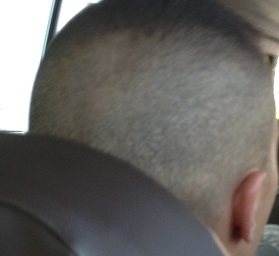
There was one young gentleman sitting in front of me on the airport shuttle.

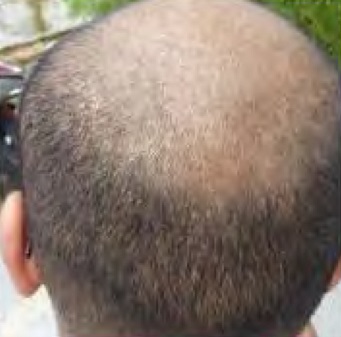
I was looking around, and all of a sudden, I saw thousands of small round bald spots at the back of his head. I realized immediately that they are the recently popular FUE scars.

The size of FUE punch usually range from 0.8 mm to 1 mm. It is assumed the scar would be the same size, but the fact is that the scar always grows bigger than the size of the punch. The more tension of the scalp the bigger the scar. 

People spend 2-3 times the surgery fee and transection rate is much higher just to have the option to have a short hair cut. However, they really don't have option to shave their head. If their barber cuts their hair too short then they will be bothered for weeks before hair grows long enough to cover the scars. At the same time, it is a big problem for their barber too, they don't have any idea how short they can cut without the scars showing. 

Under direct sunshine requires much longer hair to cover then indoors, which is the standard they should perform.  

Attached are two photos which I used an  Iphone to take.The shuttle was very jumpy, hard to focus on.


Wednesday, February 22, 2012

Compare the Quality of FUE Graft and FUT Graft


FUE grafts are cut blindly using punch, basically are bare grafts, no tissue at button part. No study discuss about regrowth hair rate, quality and life time yet.


FUE Grafts:


FUT grafts are cut under microscopic direct vision, contain a lot of tissue including regrowth elements bulge and sebaceous gland.

FUT Grafts:


Which type of graft do you prefer?


Thursday, October 01, 2009

Paired Graft vs. Intact Graft

From July 2009 Dr. Michael Beehner’s report ~

One intact 2- hair graft: contain two single hairs follicular unit. This can also be cut into two 1-hair follicular units (paired graft). *paired graft=combine two grafts and insert into one slit.


One intact 3-hair graft: contain one single hair follicular unit and one two-hair follicular unit. This can also be cut into one 1-hair and one 2-hair follicular unit (paired graft).


BFU=Bi-Follicular Unit


Conclusion from Dr. Michael Beehner:

Intact follicular unit’s growth rate is better than paired grafts (93% vs. 70%)
3-hair follicular unit has higher growth rate than 2-hair follicular units. (99% vs. 83% on intact 2-hair graft, 49% on paired graft 1 hair+1 hair

Comments:
Intact follicular units and 3-hair follicular units are our modified follicular units (bi-follicular unit). Paired grafts are single follicular units. This is why our modified follicular unit (bi-follicular unit) has higher growth rate.
Another reason why we opposed to the paired graft is that the goal of hair transplant is to minimize the empty spaces among the grafts. When transplant same size of donor area and hair, paired grafts will increase the empty space.

The photo below shows the scalp skin. If you paired the blue circled hair into adjacent hair, the empty area will increase almost four times.


From another point of view, the intention of hair transplant is to use lesser amount of hair to cover a bigger area. But when you pair grafts, it covers less area. That’s against the purpose of hair transplantation.

Look at the picture above and imaging that if you paired all the hairs, the empty space becomes huge and unnatural. If you want to keep same space then we have to remove 50% of empty skin. Transplant area will be reducing to 50% smaller area.

Thursday, February 01, 2007

Why We Don't Use FUE

When Dr. William Rassman first presented the Follicular Unit Extraction (FUE) method in 2002, almost every hair transplant surgeon criticized it as it taking us back to the old punch age. The FUE punch measured 0.8mm in diameter, much smaller than the 4mm original punch, and caused more transection than the older technique.

Over time Dr. Rassman convinced some surgeons to use his method. Dr. Jim Harris then improved the FUE punch to reduce the transection rate.

Let's evaluate the pros and cons of FUE.

The advantages of FUE:
1. No linear scar/minimizes scarring
2. Can use body hair as donor hair
3. Better for smaller surgeries (i.e. eyebrows, facial hair, touch-ups, scar cover-up)
4. For limited donor hair availability
5. For persons whom would like to wear their hair short


Rebuttal to Advantages:

#1-No linear scar does not mean no scar at all, it still leaves hundreds even thousands of small, round scars, whereas with the trichophytic closure method (discussed on 1/30/07 - Hair Can Grow Through Donor Scar), the linear scar is almost invisible.(as picture below)


#2-In Dr. Rassman's New Hair News volume 12, 2007 comment on body hair transplants, he stated: “in the live patient viewing, one doctor presented two patients who had body hair transplanted into the scalp. The aesthetic impact was negligible fuzz on the top of the scalp…Based upon what I saw, the value of body hair transplants to the scalp may only have experimental value in today’s surgical practice.”

#3-A small area such as eyebrow needs 300 to 400 grafts. With the strip method, we need a linear donor skin of 1 cm in width and 5 cm in length. When the hairs are shaved, it will show a 5-cm long fine scar. With FUE, it will show 300 to 400 small punched scar. Which scar looks more natural?


#4-With limited donor hair availability the small scars are even more visible.

#5-Extremely short hair leads to the possibility of FUE scars and linear scars being visible. Patient cannot shave his head with either procedures.

Further disadvantages of FUE:
1. Price
2. Time in surgery

FUE costs 200-300 hundred percent more than the strip harvest method and requires more time in surgery. I know one surgeon in Australia who takes one week to finish one patient. Is it worth the time and money?

Further disadvantage of FUE( compare to strip method)

*Quality of grafts can't compare this strips method.
FUE is blind punch method, strips method is cutting under microscope direct vision.
Which way will produce better guality of the grafts? And better result of regrowth?
* When hair loss progress, FUE patients will be converted to strips method's patients.
* After extensive FUE procedure, because of scars and lower density. The result of strips
method will be discount.

One hair transplant physician states that, "I have practiced FUE for the past five years. Most of my cases are strip FUT, but I perform an average of two FUE cases per week. Unfortunately, there are unscrupulous practitioners who advertise FUE as a scarless surgery and, therefore, many prospective patients present requesting FUE out of this expectation. Patients must understand that there are punctate scars. Granted, they are not visible when FUE has not been extensive, but can be readily detected when harvesting has been extensive and donor hair worn very short."