Thursday, May 01, 2008

Happy Patients

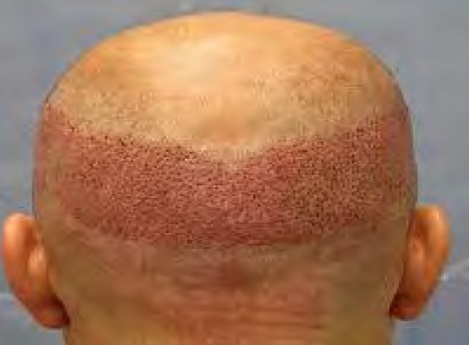
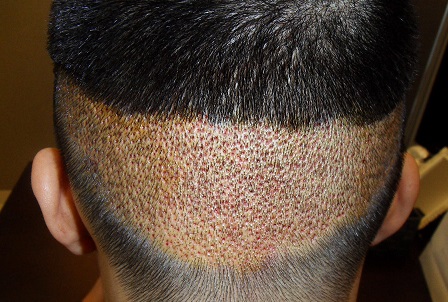
Great results don't require using all single follicular units. For this fine haired gentleman, we only used 50 single follicular units (SFU's). Please listen to his testimonial.

One Surgery
Donor Size=30 sq. cm, Coverage Area=92 sq. cm.

Density=30/92 which gives 32%
Number of grafts used: 50 single follicular units &
1232 modified follicular units. Total number of grafts=1282

Date of surgery-August 9, 2007 and then eight months after one surgery (Photo taken on April 24, 2008)


Monday, March 31, 2008

Super Dense Packing-92 grafts per sq.cm.

Surgery Date: December 7, 2006


Patient designs preferred eyebrow shape.


The length of the eyebrow is about 5 cm.


The widest part is 0.6 cm.


The narrowest part is about 0.2 to 0.3 cm.
The eyebrow area is 5 cm x 0.6 cm=3 cm2 on each side.


The eyebrow outline is about 11 cm (5cm +5cm+0.6cm +0.3cm).
We made 125 slits on the outline, the distance between each graft is about 0.8 mm.


We made 277 slits on an area of 3 cm2.
(The slit number depends on graft number available.)


This photo shows same direction of transplanted hair and original eyebrow hair.
(Coarser hair is the transplanted hair and the fine hair is original eyebrow hair.)


We transplanted 277 grafts on one side of eyebrow (area=3cm2).
This is about 92 grafts in one centimeter square.


June 20, 2007
Six months after surgery- Our patient was very happy with the results. We have achieved his goal in one surgery.


Comments:
The average density on this eyebrow is 92 grafts per cm2. Should I be proud of it? No. Not at all. Every hair transplant facility should have no problem to achieve this super dense packing. As long as you make the slits very small and trim all the tissues around the hair.

Our clinic can achieve 92 % density easily, but why we do not perform super dense packing on all hair transplant procedures?

I have checked the growth rate of the eyebrow hair six months after the surgery; the total re-growth is 455 hairs. The growth rate is 82%. Our average growth rate for hair transplants on the scalp is about 96%. In other words, with the super dense packing technique, we have sacrificed 14% of hair.

The super dense packing method is not suit for all potential hair transplant patients. Factors such as skin color, contrast, hair quality, degree of baldness and the texture of someone's hair can require a different size of graft to achieve the best result. We will work with cases individually to best fit the wants and needs of the patient.

For comparison reasons, please see the following three photos:

Our regular hair transplant grafts


Grafts used for super dense packing


Grafts used in live surgery meeting


Which one do you think will have the best growth rate?


Tuesday, April 10, 2007

Hair Transplant Progress-with ten months photos

Here you can see one of my patients' post-surgery progress.

Surgery Date: 08/26/2006

Coverage area: 68 sq. cm.
Donor area: 29 sq. cm.
Donor Density Increased: 40%

The photos are taken before surgery.


Immediately after the surgery-
For the first twenty-four hours, there will be a strip of bandage around the head. After that, you will be able to remove the bandage and shampoo your hair.
Some graft may appear whiter initially and will have same color as rest of grafts couple hours later.
The hairline design is irregular.
We implanted 200 single follicular units on hairline and 1200 modified follicular units.

9/8/2006
Two weeks after the surgery, scabs already fall out.


9/19/2006
The implanted area looks pink, the color should return to normal 4 to 8 weeks after surgery.


10/13/2006

Transplanted hair starts to fall out. Skin color returns to normal.


10/31/2006


Two months after surgery-

Pre-existing hair around or adjacent to the transplanted grafts may shed, giving a thinner look, but will begin to grow back within a few months.


11/29/2006


Three months after surgery-


One or more cysts may occur in the recipient area. They usually disappear by themselves after a few weeks.


12/12/2006


12/27/2006


Four months after surgery-

Transplanted hair should grow back 4 to 6 months after surgery.


1/22/2007


Five months after surgery-

More hair come out


2/7/2007


Hair look denser...


2/20/2007


And denser..


3/5/2007


Also coarser..


3/20/2007


4/5/2007


Seven months after surgery-


Ninety percent of the patients will be satisfied by 50% to 60% of donor site density. He received 40% density, which looks pretty good when seeing from the front.


6/22/2007

Ten months after surgery. :-)


Friday, April 06, 2007

Hair Transplant Progress Result

After the surgery is complete, the results should appear within the next couple months.

24 Hours After-
Bandages can come off. Soreness may be felt at the donor area.

One Week After-
Tiny scabs on graft area will start to disappear.

One Month After-
Transplanted hair will fall out.

4-6 Months After-
New hair starts to grow.

6-8 Months After-
Transplanted hair continues to grow and thicken.

One Year and After-
Final appearance of procedure is usually present.


Please see video of the Hair Transplant Progress!

Tuesday, February 27, 2007

Punch Graft Correction

The 4 mm size grafts were transplanted more than 20 years ago. Everyone blames the big grafts for causing the pluggy look. I think the big graft is only the indirect reason for the pluggy look. The graft is too big to place close enough to each other.


The direct reason is too big of the spaces among the grafts. If we are able to fill in all the spaces then the pluggy look will disappear. It is unnecessary to remove the big grafts. By not removing the large graft, they will help to increase the density and make the final result easier to achieve.

Please study the photos, to observe two facts.
1. Please notice the huge spaces among the grafts.

2. The large graft has the original density. Within the 4 mm graft, the distance among the hairs is kept in their original density. The hairs are appropriately spaced. The size of the graft is not the problem; the hairs are in their original form and not squeezed into a smaller space. The problem lies in the fact that the grafts (also known as plugs) are spaced too far apart from each other and the space in-between the grafts accentuate the pluggy look.
Immediately after we made the slits
The goal is to fill in all the spaces between the punch grafts.

Please see Surgical Correction of ‘Plugginess’ in Hair Transplants
Published on Hair Transplant Forum International
January/February 2006 Volume 16, Number 1

Scar Cover Up


The scar is very small, but it always bothered her because it showed up in her part line. It is visible to everyone when she parted her hair.
Six months after a small touch up, she doesn't have to worry about people seeing her part line anymore.

Thursday, February 22, 2007

Young Patients-#4


This young patient is a 28 year old male who had been taking Propecia for three years. He had not noticed any changes in his condition and wondered if he should continue taking the medication, or even if he needed it in the first place.
Recommendation: Take photos on consultation date and discontinuepropecia for three months. Then take photos with the same angle, light, hair style and length tofor comparison purposes.
Lesson: Always take pictures before taking Propecia. The hair growthis slow (6-8 months)
making it difficult to notice the results. On the other hand, Propecia may not be the right hair loss solution for some patients. I have seen patients who don't think the medication is helping, but are so afraid of hair loss that they continue taking it anyway. Never forget to take pictures before taking Propecia to chart your own progress.

Question: Exclusive use of single follicular units (SFU) seems to be the current norm, why does NHT insist on using mixed sized grafts?

Question: Exclusive use of single follicular units (SFU) seems to be the current norm, why does NHT insist on using mixed sized grafts?

Answer:
There are a number of reasons why many surgeons today use only SFU for hair transplants. Exclusively using SFU for hair transplants provides a more even "look" and fewer scabs immediately after surgery. As an additional benefit, surgeons can pack SFU more densely than modified follicular units.

However, there are three concerns:
1. Higher telogen (resting) stage hair loss due the process of thin graft preparation

Humans typically shed 60 to 100 hairs per day. These telogen stage hairs, or resting hairs, amount to 10% to 15% of our total hair at any given time. After about three months, the hairs re-grow and start the natural process over again. Telogen stage hairs are of concern for hair transplants because they are effectively invisible. In the process of preparing an SFU, the technician must trim off the tissue next to the SFU grafts possibly discarding the invisible hair inside the tissue. 10% to 15% of hair may be lost in this trimming process.

Photo: 10% to 15% of hairs are in Telogen Stage and are invisible.


2. Poorer growth rates when using thin grafts compared to "chubby" graft
Dr. Seager, Dr. Beener, Dr. Beeher, Dr. Reed and Dr. Raposio each conducted studies to compare the results of chubby and thin grafts. These studies found that growth rates for chubby grafts' are 20% to 51% faster than the thin grafts. So far we haven't heard any report indicating that the thin graft's growth rates are better.

Photo: Thin follicular units-almost no tissue attached

Photo: Thin Follicular Units - tissues are trimmed off


Photo: Chubby Follicular Units


Photo: Chubby Modified Follicular Units

3. Cost to patient is almost double when using SFUs only

The cost associated with a hair transplant surgery is also an important issue. We work hard to earn our incomes - why should we waste it if we have a more affordable alternative to achieve our goal.

For example, here is a cost estimate for a typical SFU-only hair transplant for a hypothetical patient.
Assumes:

  • A recipient area of 80 cm2
  • A donor size of 40 cm2 needed for a 50% transplanted density
  • Donor area contains about 100 FUs in one cm2
  • Total grafts needed are around 4000 SFUs
  • Total cost is around $20,000 at $5 per graft


In reality this surgery would likely cost much more than this estimate; in this calculation we didn't take into consideration potential hair loss during surgery or the growth rate.Remember that hair loss is a life long process. A patient needs to receive touch-up hair transplants once in a while to maintain a good "look". Over the longer term, the exclusive use of SFUs adds up to quite a sum!

Wednesday, February 07, 2007

Question: Do I need to come back for suture removal?

Question: Do I need to come back for suture removal?


Answer:


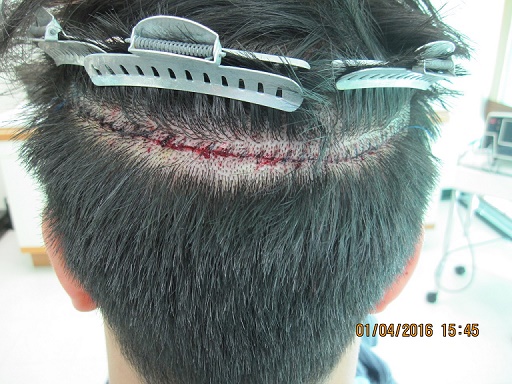
At NHT Medical Center we use a polyglactin 910 suture to close the donor area. I prefer using sutures to staples because they are more comfortable for the patient and result in a less noticeable scar. In addition, these absorbable sutures begin to fall off on their own 7 to 10 days after surgery as the wound heals. The patient does not have to return for suture removal saving him a trip back to the office.

This photo is of a donor incision five days after surgery. At this point you can no longer see the suture.


An article in the 1999 Journal of the Canadian Dental Association reported on the advantages of the polyglactin 910 suture compared to staples. In the survey, researchers evaluated 42 patients with scalp wounds from cosmetic surgeries. They closed half the wound with the irradiated polyglactin 910 vicryl rapide fast-absorbing suture and the other half with traditional staples. In the study of these 42 patients they found:

· No inflammatory reaction in the areas closed with the absorbable sutures compared to 1 case in the wounds closed with staples
· An average pain score of 1.82 reported by patients for the sutures compared to average pain score of 6.7 for the staples
· No patient reported suppuration, hypertrophic scarring, or alopecia with either method
· All 42 patients in the sample preferred sutures to staples